
AI resume screening: how to evaluate candidates without losing context
AI resume screening can turn a large applicant pool into a reviewable shortlist, but the ranking is only as useful as the role criteria and evidence behind it. This guide shows how to design, test, and govern a screening workflow recruiters can inspect.
HyreSure product guide · Updated August 10, 2026 · 8 minute read
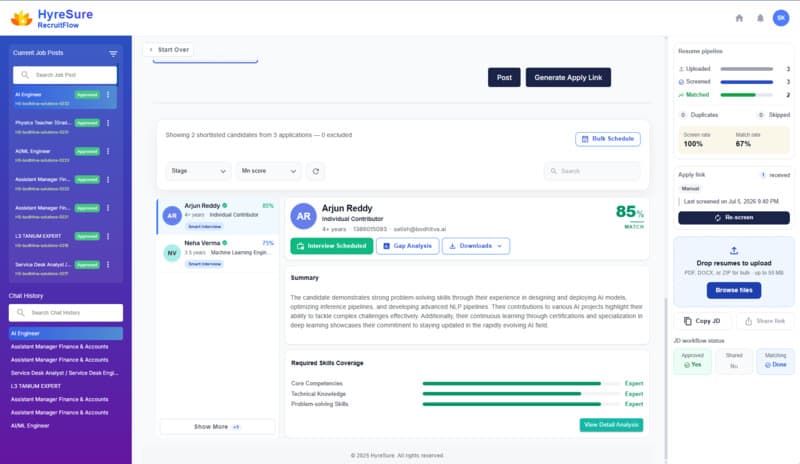
How AI resume screening works
A screening system extracts information from a resume, compares it with the role criteria, and organizes the applicant pool for recruiter review. More capable systems consider context and related experience instead of relying only on exact keyword matches. The output may include a match score, evidence, missing criteria, and a ranked shortlist.
The system does not know what matters for the role unless the team defines it. A vague job description can produce a confident but unhelpful ranking. Treat role calibration as part of screening: distinguish requirements from preferences, define acceptable alternatives, and identify criteria that cannot be inferred safely from a resume.
- Parse the resume into experience, skills, education, and other relevant signals
- Compare those signals with explicit role criteria
- Show matching evidence, uncertainty, and missing information
- Organize the pool for recruiter review rather than make the final decision
Build criteria recruiters can defend
Start with the work to be performed, then identify the minimum evidence needed to advance. Separate must-have qualifications from skills that can be learned, and avoid using proxies simply because they are easy to extract. The hiring manager and recruiter should agree on the criteria before reviewing the ranking.
Ask the platform to show how a non-traditional candidate can demonstrate equivalent experience. Good screening supports calibration: reviewers can adjust criteria, inspect how the pool changes, and understand why candidates moved rather than receiving a completely new black-box result.
- Required versus preferred qualifications
- Equivalent skills, adjacent experience, and transferable evidence
- Minimum experience without arbitrary prestige proxies
- Criteria that require a later interview or work sample
- A documented reason for every material filter
Explainability belongs in the recruiter workflow
A percentage alone does not tell a recruiter whether the match is credible. The review screen should connect each conclusion to resume evidence, distinguish missing information from a true gap, and let a person inspect borderline candidates. It should also preserve the criteria and model output used at the time of review.
Human oversight needs a specific mechanism. Decide who samples results, who can change criteria, what triggers a manual review, how corrections are recorded, and whether an automated action is ever allowed. These controls are more meaningful than a generic claim that a human remains in the loop.
- Evidence attached to every important match or gap
- Uncertainty shown instead of converted into false precision
- Reviewer overrides with a reason and audit history
- No silent rejection based only on an unreviewed score
Test screening quality before scaling volume
Build a pilot set that includes strong matches, weak matches, non-traditional backgrounds, career gaps, formatting differences, missing details, and candidates recruiters disagree about. Compare the output with the agreed criteria, not only with past hiring outcomes, which may contain inconsistent judgments of their own.
Measure recruiter review time, evidence accuracy, missed qualified candidates, false positives, corrections, and agreement after reviewers inspect the evidence. Expand only when the team trusts both the quality of the shortlist and the process for finding and correcting mistakes.
- Use real role criteria and representative application volume
- Review false positives and false negatives in detail
- Re-test after changing criteria or workflow configuration
- Document ongoing sampling and calibration after launch