
Three products. One candidate story.
RecruitFlow, SkillBoard and InterviewHub share one login, one candidate context and one report trail, so each stage starts where the last one stopped. Use them together or start with one. Below is the software itself.
RecruitFlow: screening you can explain
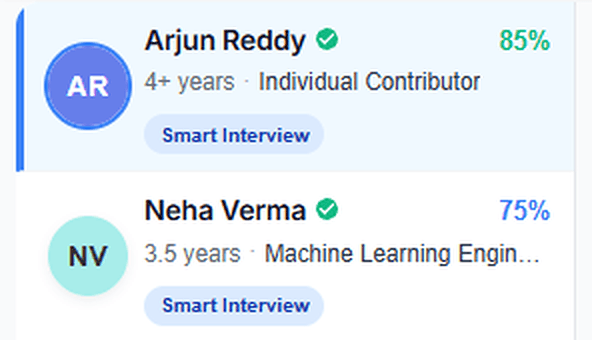
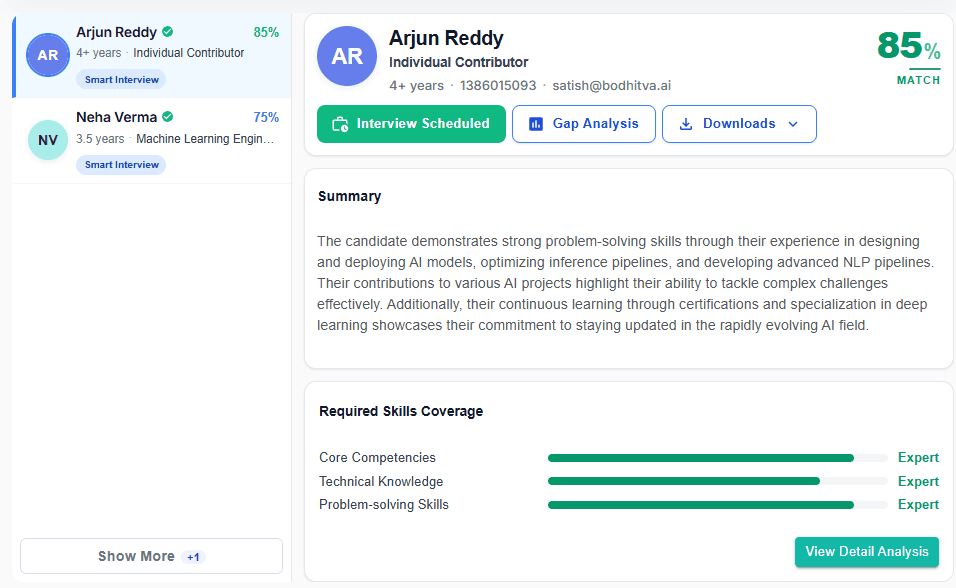
Create or upload a JD, ingest resumes in bulk, and get consistent, explainable match scores with the gaps worth probing. It reads meaning rather than keywords, and the same resume and JD always get the same score.
- AI-assisted job descriptions, or ingest the JD you already use
- Primary and secondary skill identification, so scoring reflects what matters
- Skill equivalence: AWS and Amazon Web Services are one capability, not two
- Gap analysis across experience, skills, responsibilities, and qualifications
- Parallel screening at volume, with deduplication across vendors and roles
- Same resume, same JD, same score, with each skill marked Matched, Partial or Missing
What it produces: a ranked shortlist where each match score opens into the skills matched, the evidence behind them, the requirements missing, and what the next stage should validate.
SkillBoard: fair, proctored assessments
Every candidate gets a fair test, even with randomized questions. Your question banks come first, AI fills the gaps at equal difficulty and weight, and the assessment draws on the same industry, domain and job context as the interview.
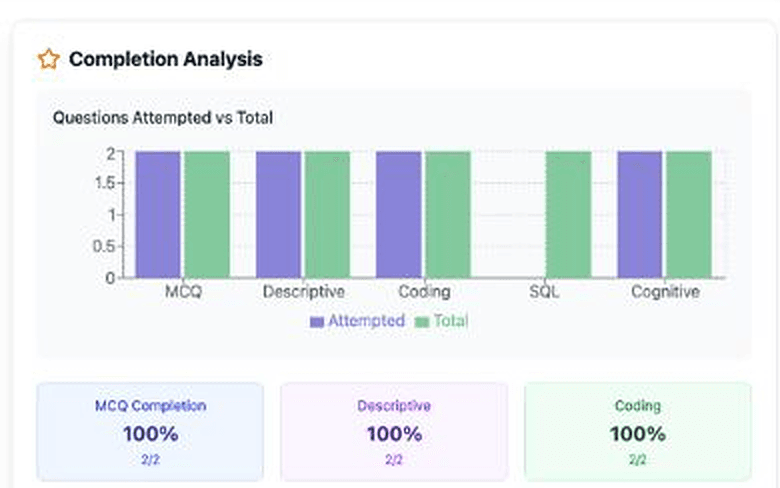
- MCQ, descriptive, coding, SQL, audio, video, cognitive, and behavioural formats
- Questions aligned to the JD, seniority, difficulty, and evaluation objective
- Question pools, randomization, and paraphrasing to reduce predictability
- Code execution with test cases, timeboxing, and system checks
- Integrity signals: fullscreen, tab switching, copy and paste, developer tools, video
- Section-level scores, topic proficiency, and comparative reporting
What it produces: demonstrated capability per topic, with integrity violations reported as timestamped evidence and captured frames rather than an unexplained score.
InterviewHub: AI interviews that know the job
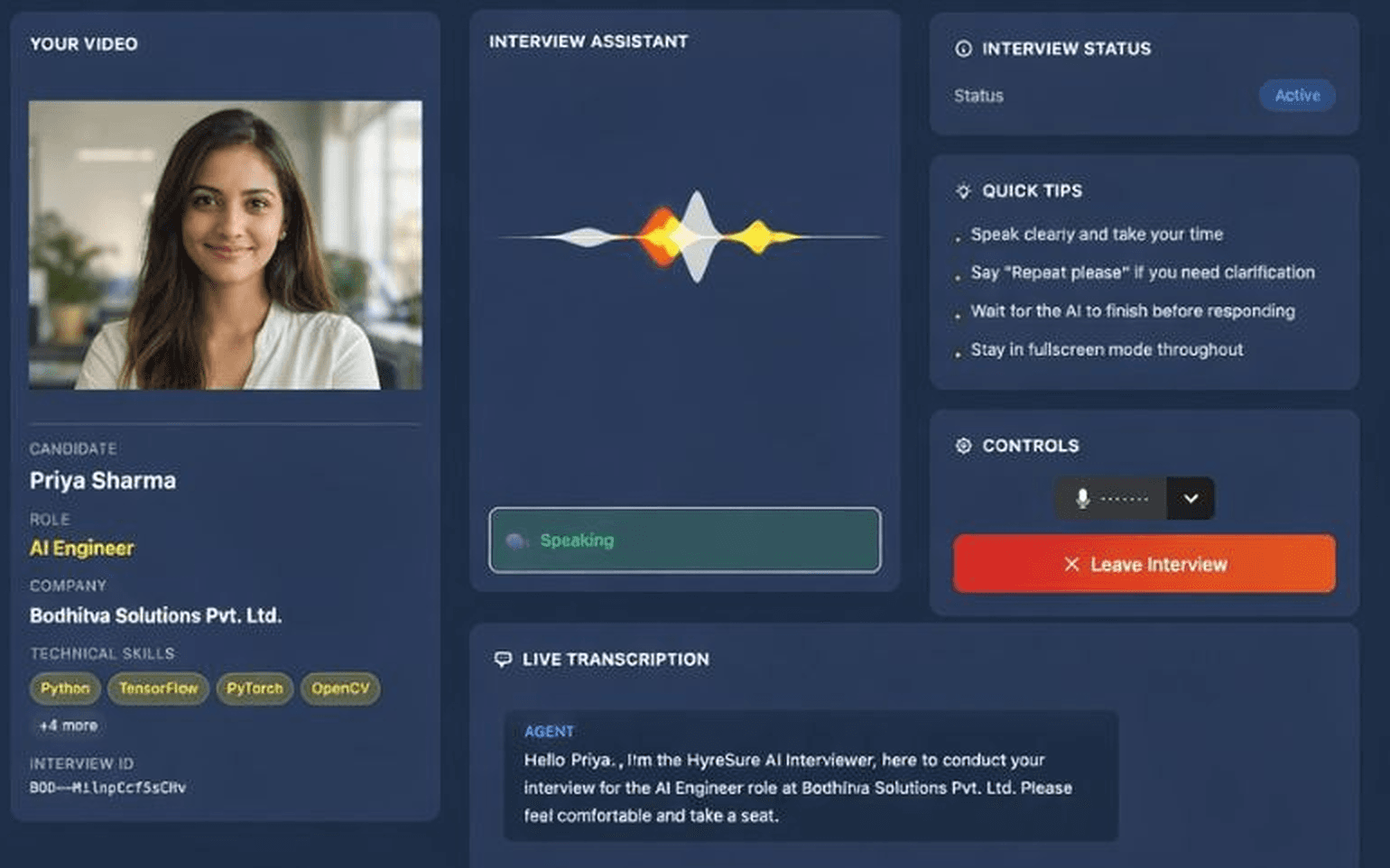
Interviews that adapt to the role, the domain and the candidate's gaps, with a full recording, transcript and report. When someone says they designed a microservices architecture, it asks how service boundaries were drawn, what broke, and what they would change today.
- Hundreds of ready-to-use Knowledge Packs, customizable to your needs, setting the skills, depth, scoring, and flow
- 24 interview languages, including 11 Indian languages
- Six interviewer personas with different voices, accents and tones
- Voice and video interviews with follow-ups driven by the candidate's answers
- Questions informed by the JD, resume, identified gaps, and assessment performance
- Competency scoring, soft-skill evaluation, and question-level analysis
- Communication analysis, mappable to frameworks such as CEFR where appropriate
- Candidate verification, liveness checks, recordings, and full transcripts
- Standardized scoring dimensions and normalization, so candidates compare
What it produces: a reviewable interview record — transcript, per-question evaluation, strengths, concerns, and what a human interviewer should still validate — instead of hours of raw recording.
Deep in any role. Natural in any language.
What decides whether an AI interview is worth reviewing? What it knows to ask, and whether the candidate can answer naturally. InterviewHub settles the first with Knowledge Packs, and the second with 24 interview languages and six interviewer personas.
Knowledge Packs
A Knowledge Pack is a versioned module of role expertise. Attach one while scheduling and it sets the skills the interview covers, the depth it probes, how answers are scored, and how the conversation flows.
- Hundreds of ready-to-use packs across roles, seniority levels, and domains, each customizable to your needs.
- We also create custom packs specific to your domain and hiring needs.
- Every pack declares the role families it covers — individual contributor, hybrid, leadership — so it is never applied to a level it was not written for.
- Packs carry a version, so you always know which profile a candidate was interviewed against.
- Before scheduling, open the pack and read its skills, scoring, flow, and the questions a candidate could face, each tagged with its competency and depth level.
- A pack is optional. With none attached, the interview runs from the job description and role instead.
Six interviewer personas
Six distinct interviewers with different voices, accents and tones, so the interview fits your brand and your candidates.
- Match the interviewer to the role, the region and the candidates you are hiring.
- The candidate answers in the language they think in, which is a better test of reasoning than a test of English.
- The same Knowledge Pack depth and evaluation standard applies with every persona and in every language.
24 languages, 25 locales
English (India) and English (US) are separate locales, and every other locale resolves to its own localization rather than falling back to English.
India
English and ten Indian languages, each with its own localized interview experience.
- Bengaliবাংলা
- English (India)
- Gujaratiગુજરાતી
- Hindiहिन्दी
- Kannadaಕನ್ನಡ
- Malayalamമലയാളം
- Marathiमराठी
- Odiaଓଡ଼ିଆ
- Punjabiਪੰਜਾਬੀ
- Tamilதமிழ்
- Teluguతెలుగు
International
European, Middle Eastern, and East Asian languages for global and offshore hiring.
- English (US)
- Arabicالعربية
- Chinese中文
- DutchNederlands
- FrenchFrançais
- GermanDeutsch
- Hebrewעברית
- ItalianItaliano
- Japanese日本語
- Korean한국어
- PolishPolski
- PortuguesePortuguês
- RussianРусский
- SpanishEspañol
Each stage answers what the last one couldn't.
Evidence accumulates instead of repeating. A candidate moves from an unverified claim to a documented capability, and the gaps found early decide what gets tested next.
- ClaimedResume
What the candidate says they have done: skills, experience, qualifications.
- InferredRecruitFlow
What career history reasonably supports: depth, skill relationships, progression.
- DemonstratedSkillBoard
What they can do under assessment: knowledge, reasoning, code, written explanation.
- InteractiveInterviewHub
How they reason and defend decisions when questions follow their own answers.
- UnifiedOne report
Every signal in one place: scores, transcript, recording and integrity evidence, for your team to review.
Every skill is marked Matched, Partial or Missing with the evidence shown, and people make the decision. How explainable scoring works.


Run it on one of your own job descriptions.
We will screen real resumes against it, show the gap analysis, and walk through an assessment and an AI interview, so you see the evidence each stage produces rather than a scripted tour.