
How to evaluate an AI interview platform
The label AI interview platform covers several different products. Some conduct an interview, some record an asynchronous response, and others summarize a human-led conversation. A useful evaluation starts by deciding which job the software must do.
HyreSure product guide · Updated August 10, 2026 · 8 minute read
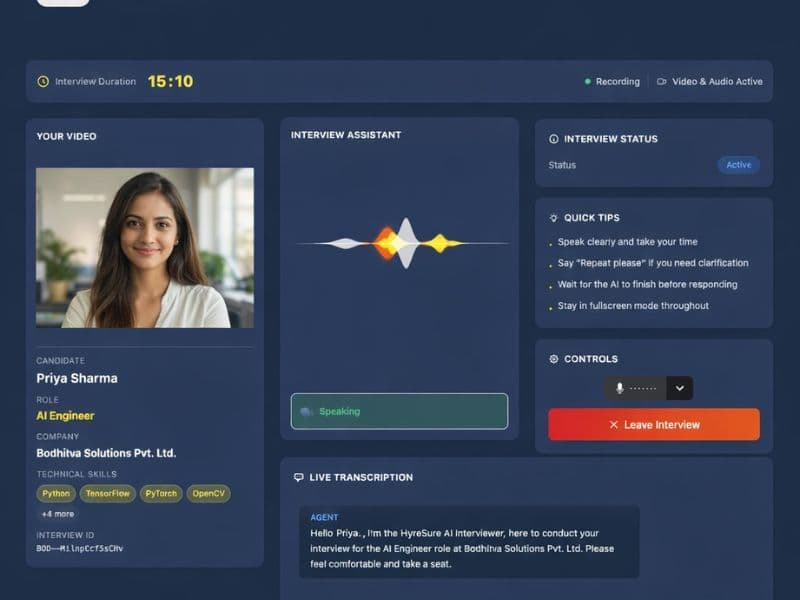
First identify the interview category
An AI-led interview platform asks questions, interprets the response, and chooses role-relevant follow-ups during a live voice or video conversation. An asynchronous video platform records responses to a fixed set of prompts. Interview intelligence software joins a human-led call to create notes, transcripts, or coaching insights.
These categories can overlap, but they solve different constraints. A team short on first-round interviewer capacity needs a different product from a team that already runs interviews and only needs better documentation. Ask every vendor to demonstrate the exact candidate and recruiter workflow instead of accepting a broad feature label.
- AI-led conversational interview
- One-way or asynchronous video response
- Scheduling and candidate coordination
- Human interview recording and intelligence
- Interview scoring and decision support
Treat candidate experience as a product requirement
Candidates should know that they are interacting with AI, what will be recorded, how the information will be used, and where to request help or an accommodation. Instructions, device checks, consent, question pacing, and recovery from a network interruption are part of the interview quality, not administrative details.
Test the platform from the candidate side on common devices and network conditions. Include different accents, concise and long answers, requests for clarification, and accessibility scenarios. A smooth recruiter dashboard cannot compensate for an interview that candidates cannot complete confidently.
- Clear disclosure and consent before the session
- Accessible instructions and a support path
- Stable audio, video, transcription, and reconnection
- Consistent timing without rushing thoughtful answers
- Transparent explanation of the next step
Inspect the evidence behind every interview score
A score is useful only when a reviewer can understand the competency, rubric, candidate response, and reasoning that produced it. Look for a review screen that keeps the transcript, summary, supporting excerpts, and rubric together. Hiring managers should be able to disagree with a score without losing the original record.
Consistency comes from the interview plan and rubric, not from asking every role the same questions. The platform should let the team define role-specific competencies, acceptable follow-ups, scoring anchors, and topics that the system must avoid or escalate.
- Role-specific competencies and scoring anchors
- Transcript or recording linked to each conclusion
- Visible follow-up questions and candidate responses
- Reviewer comments, overrides, and audit history
- A clear boundary between recommendation and decision
Run the pilot with recruiters and candidates
Use a role your team understands well and compare the platform output with an existing structured interview process. The goal is not to make the AI agree with every historical decision. It is to determine whether the system gathers consistent, relevant evidence that people can review more efficiently.
Track completion, support requests, recruiter review time, rubric agreement, corrected scores, and hiring-manager confidence in the evidence. Interview automation is ready to expand when the candidate experience is reliable and reviewers can explain how the output informed their judgment.
- Test ordinary and difficult candidate scenarios
- Review a sample of every outcome during the pilot
- Collect candidate and recruiter feedback separately
- Document calibration, escalation, and retention ownership