
AI recruitment automation: a practical guide for hiring teams
Recruitment automation is most valuable when it removes repetitive work without hiding the evidence or ownership behind a hiring decision. This guide explains where AI fits, how to select the first workflow, and what to measure during rollout.
HyreSure product guide · Updated August 10, 2026 · 9 minute read
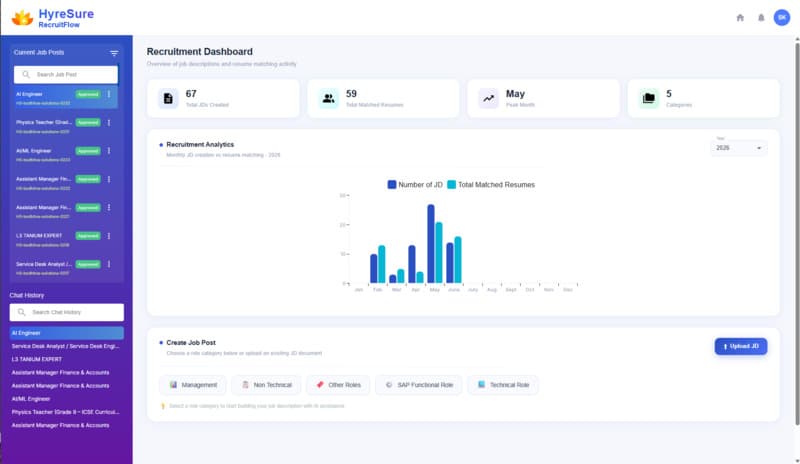
What AI recruitment automation actually includes
AI recruitment automation uses software to reduce manual work across role creation, job publishing, applicant screening, interview coordination, structured interviews, skills assessments, reporting, and recruiter handoffs. It is broader than an applicant tracking system, which primarily stores applications and manages pipeline stages.
The useful boundary is not human versus machine. It is repetitive processing versus accountable judgment. Software can compare applications against explicit criteria, conduct a consistent first-round interview, or assemble a scorecard. A person should still own the criteria, inspect the evidence, handle exceptions, and make the consequential decision.
- Role and job-description creation
- Applicant matching and shortlist preparation
- Structured voice or video interviews
- Skills, coding, and work-sample assessments
- Evidence capture, reporting, and reviewer handoffs
Map the workflow before selecting software
Start with a recent role and trace every step from approval to shortlist. Record who performs the work, how long it waits, what information enters the step, what evidence leaves it, and which system owns the record. This exposes delays that feature checklists usually miss.
Choose the first automation target where volume is high, the rules can be stated clearly, and a reviewer can verify the output. Resume triage, repeatable screening interviews, and standardized skills checks often meet those conditions. Final selection, sensitive exceptions, and ambiguous evidence usually need more human involvement.
- How many applications or interviews enter the step?
- Can the acceptance criteria be explained to another recruiter?
- What supporting evidence must remain visible?
- What happens when the system is uncertain or wrong?
- Who approves a candidate moving to the next stage?
Evaluate the operating model, not just the feature list
Two platforms may both claim screening, interviews, and assessments while producing very different recruiter experiences. Ask the vendor to demonstrate how criteria are configured, how scores trace back to evidence, how people can correct an output, and how the decision record moves into the existing ATS or reporting process.
Modularity matters when teams have different levels of readiness. A screening tool, interview platform, or assessment product should be useful independently. If the products connect later, the integration should reduce handoffs without forcing every team into one launch.
- Explainable recommendations and reviewer overrides
- Permissions, audit history, retention, and export controls
- Independent modules with a consistent candidate record
- ATS, calendar, identity, and reporting integrations
- Candidate consent, accessibility, support, and escalation paths
A measured rollout beats a big-bang implementation
Run the first pilot on one representative role with real recruiters and realistic edge cases. Establish a baseline before turning on automation: reviewer time, time between stages, completion, candidate drop-off, correction rate, and the usefulness of the evidence delivered to hiring managers.
Review outputs weekly during the pilot. Look for criteria that are too broad, scores that reviewers cannot explain, candidates who are consistently misread, and handoffs that still require copying information. Expansion should follow demonstrated quality and adoption, not the number of features configured.
- Weeks 1-2: map the process and define measures
- Weeks 3-4: configure one role and test edge cases
- Weeks 5-8: run a controlled pilot with human review
- Weeks 9-12: calibrate, document ownership, and decide whether to expand